Overview
At a glance
- Recognition stated as one controlled difference
- A surviving residual after the cruder cue is subtracted
- One well-controlled chimpanzee gaze-following study, re-read
- Positive pole: geometric gaze-following; negative pole: local enhancement
- Verdicts match the original investigators’ structural findings
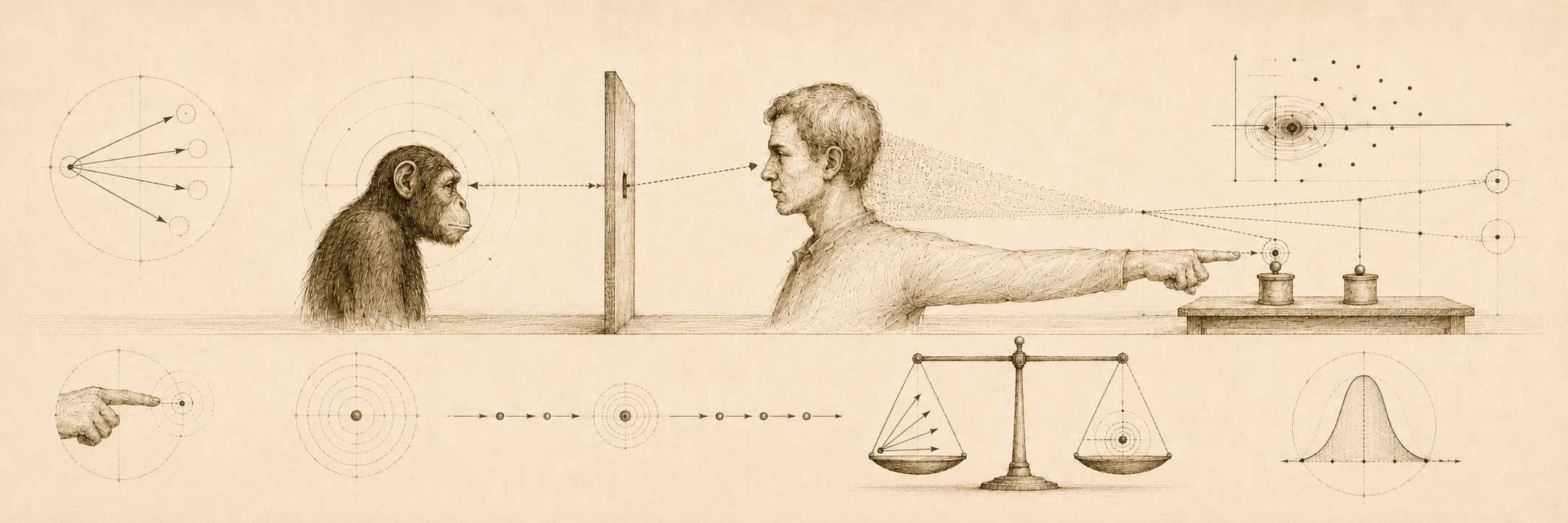
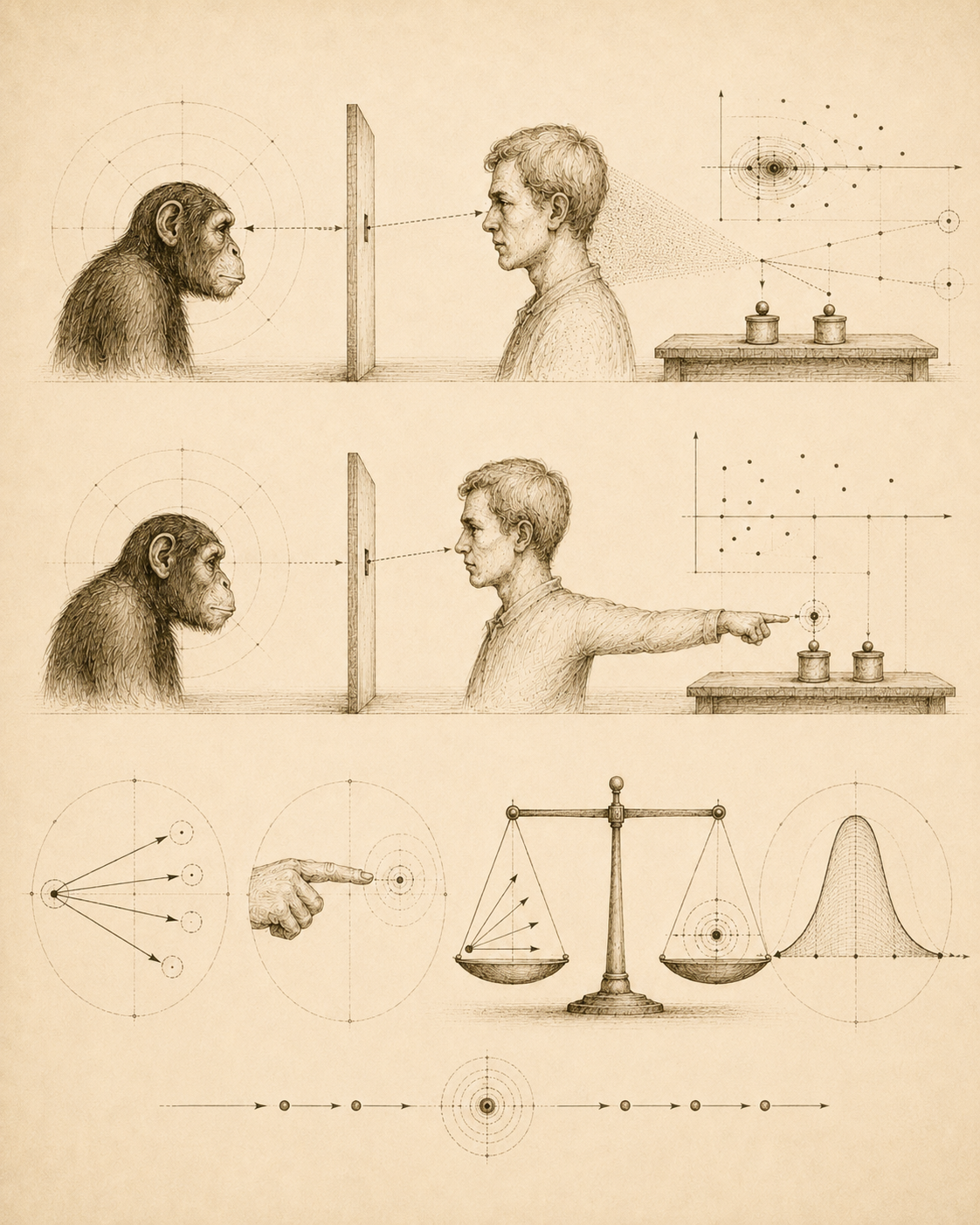
The lane’s worked case. Recognition — one animal tracking where another is oriented, rather than merely reacting to its motion — is stated as a single controlled difference: a residual that survives once the cruder cue the experiment introduces is subtracted.
The method is then read through one well-controlled published study of chimpanzee gaze-following, to ask a narrow question: applied to careful data, does it recover the structural finding the original investigators reached? It does. Where a human looks toward places a chimpanzee cannot see without moving, the residual survives and the method returns recognition — the contrast tracks where the human is oriented, not the nearest interesting thing. Where a human points right next to a baited container, the residual does not survive once proximity is removed, and the method returns detection — proximity to the hand is left as the available account.
The result is deliberately small. It shows the distinction can be drawn as a measured difference rather than judged by how vivid a response looks, and that, drawn this way, its verdicts match what careful studies found: geometric gaze-following in the one case, local enhancement in the other. The paper is candid that the two poles are not earned identically — the positive pole re-cuts the data, the negative labels a contrast the study already ran — and says so where it matters.
What it claims / What it does not claim
What it claims
Recognition as a measured difference. The orientation-tracking distinction can be drawn as a controlled residual — surviving the subtraction of a cruder cue — rather than judged by how vivid the behavior looks.
Verdicts that match careful findings. Read through one well-controlled study, the method returns recognition where geometric gaze-following was found and detection where local enhancement was, at group level.
What it does not claim
Nothing about inner life. By the paper’s own statement, it settles nothing about what such recognition is, or whether anything is going on inside the animal — the method has no terms in which that question could be put.
Poles not earned identically. The positive pole re-cuts the data while the negative labels a contrast the study already ran; the paper marks the asymmetry rather than presenting a single clean symmetric result.
Figures